
So, I’ve always liked using very serious business tools for very silly reasons. One of the very first posts on this blog was about running a job search in Jira. At that time, I’d been laid off, I had more recruiters and applications than I could keep straight in my head, and I happened to know a good deal about a highly customizable tracking tool to help organize all this rather than relying on it to live in my meat-space. So I built a JobHunt project, gave it a workflow and a dashboard, and wrote it up. That was 2019.
To this day, I still think the best way to learn what a tool is good at is to point it at something it was never designed for and see where it bends.
That leads us to today. In the United States, where I’m located, it’s the day before Thanksgiving. Here and in Canada (where they had theirs about a month ago), we typically celebrate with a big feast for our extended family and friends. As an aside, my family usually fasts the day of, ahead of the feast. That’s not for any religious reason; it’s a practical one, given how large the feast normally is.
But when I noticed the date this week, I thought of the perfect way to use Jira today: planning Thanksgiving dinner!
To be clear up front: my wife, Jennifer, and I aren’t hosting this year. We are still going to be cooking a dish or two to bring to our family, but this year we’ve been spared hosting duties. That turns what is to follow into a pure thought experiment. But I set it up as if we would really be doing it. Specifically, our constraints are:
- Two cooks. (Yes, I can cook, but my wife is the better one!)
- Two guests, each bringing one side.
- A double oven.
- A toaster oven that can pass for a small oven if you only ask it to bake something modest, like a pan of rolls or a pie.
- A refrigerator that isn’t infinite.
And a menu that would make a cardiologist reach for a chair:
- Turkey
- Rolls
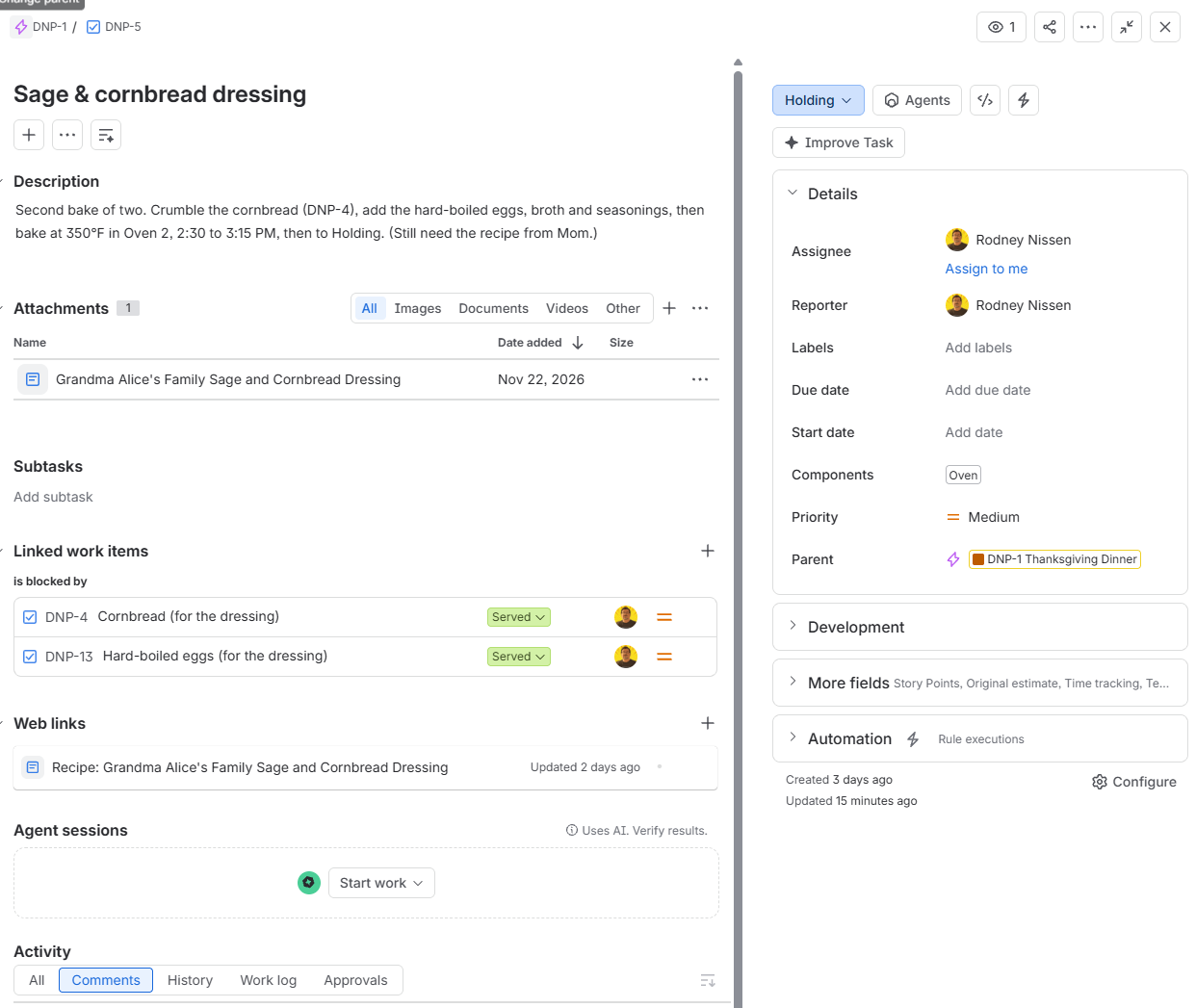
- Grandma Alice’s sage and cornbread dressing
- Jennifer’s fresh cranberry sauce
- Mashed potatoes
- Mac and cheese
- Green bean casserole
- Collard greens, with bacon
- Brownies
- Bread pudding
(I’m sorry Dr. Egolum!)
None of those dishes is hard on its own. The hard part of Thanksgiving is that ten things have to be hot, done, and on the table in the same fifteen minutes, and most of them have to pass through the same two oven doors to get there.
That is a project with a fixed delivery date, a single bottleneck resource, external dependencies you don’t control, and work items wildly different in size. And the lesson Thanksgiving teaches, if you let it, is the one most teams get backward: you don’t plan from the backlog forward. You plan backward from the finish line, around the constraint. Jira’s board will tell you when the constraint is overloaded. It will not schedule around it for you, and the ways it falls short are worth understanding before your next release.
The Backlog Is the Easy Part
So I chose to set up every dish as a work item. To help keep things organized (and reusable), I then put them all under one epic, Thanksgiving Dinner. The additional benefit is that the whole meal rolls up into a single progress bar, which is a deeply satisfying thing to watch move on Thursday afternoon.
Beyond the summary, three things matter on each work item.
The first is which resource the dish needs. Some dishes need an oven, some need the stovetop, one needs only a refrigerator and patience. I’d track those as components (Oven, Toaster Oven, Stovetop, Fridge) rather than a new custom field, partly because I’ve spent enough of my career cleaning up custom fields that somebody created for one board and abandoned. Components are a fixed list that belongs to the space, and only a space admin can change it, so nobody ends up with oven, Oven, ov en, and ovens labels on the same board. The list also carries over to the next holiday’s epic in the same space. A dish can have more than one: the cranberry sauce cooks on the stovetop and then spends the night in the fridge. The brownies need no equipment at all, so they keep a no-heat label instead. I left every component without a lead, because in a home kitchen with two cooks, nobody owns the oven.
The second is who’s cooking it. Two cooks is a real constraint, and it’s the one people forget when they stare at the oven. If my wife is mashing potatoes and I’m carving, nobody is pulling the mac and cheese out. Assignee does this job, and a swimlane per assignee makes it visible at a glance whether one of us has four things in flight while the other is holding a wooden spoon and waiting.
The third is dependencies, and this menu has more than it looks. Grandma Alice’s dressing is baked twice. The cornbread gets baked on its own first, then crumbled together with chopped hard-boiled eggs, broth, onion, celery, sage and thyme, and the whole thing goes back in the oven. So the dressing waits on two other work items, the cornbread and the eggs, and they come off two different pieces of equipment. Each one gets a blocks link to the dressing, and I tagged both with an ingredient label so a filter can tell the dishes that reach the table from the ones that disappear into something else. The two dishes the guests are bringing are dependencies too, of a nastier kind: work being delivered by someone outside the team, on their schedule, in a condition you don’t control until it walks through the front door.
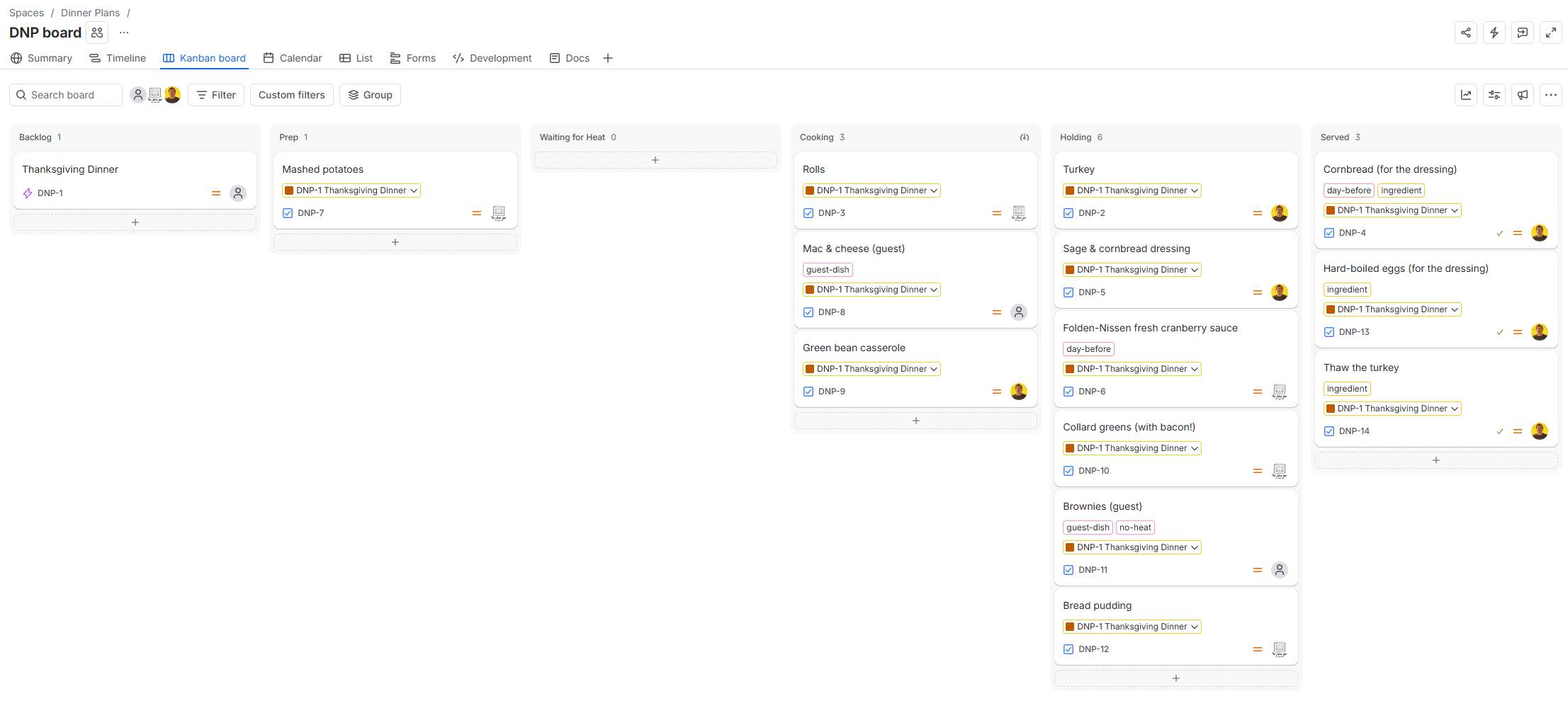
In this plan, the guests bring the mac and cheese and the brownies, and those two make a useful pair. The brownies arrive finished and go straight to Holding without touching a single oven. The mac and cheese arrives needing half an hour at 350°F, right in the busiest stretch of the afternoon. Both are external dependencies, but only one of them lands on the constraint, and that’s the distinction worth tracking on any project: which outside deliverables can just show up, and which ones need a slot on your bottleneck when they do.
A Board With Honest Waiting Columns
The obvious board is Backlog, Prep, Oven, Resting, Served. It’s a good start, but it hides the place where Thanksgiving goes wrong most often, which is the waiting. More dishes are ruined by sitting than by cooking.
So the board gets two columns whose only job is to show waiting:
| Column | What it means |
|---|---|
| Backlog | Not started |
| Prep | Someone is actively chopping, mixing, or assembling it |
| Waiting for Heat | Ready to cook, but the oven, burner, or toaster it needs is occupied |
| Cooking | In an oven, on a burner, or in the toaster oven |
| Holding | Done cooking, covered, keeping warm until dinner |
| Served | On the table |
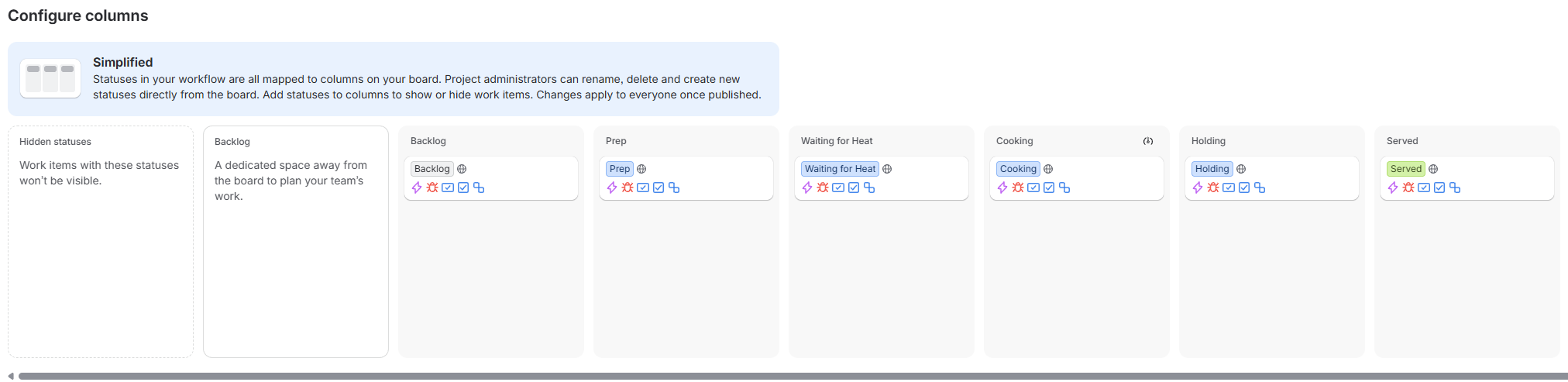
Waiting for Heat is the queue in front of the bottleneck, and it’s the most useful column on the board. When it fills up, the ovens are full, and no amount of faster chopping will fix that. That’s the first lesson I’d want any team to take from this: if your board has no column for “ready but blocked by capacity,” your work items sit in In Progress looking busy, and nobody can tell the difference between work being done and work waiting for a turn.
Holding is the other side of the same coin, and teams almost never model it. A dish that finishes at 1:00 PM for a 4:00 PM dinner gets served lukewarm or reheated, which uses oven time twice. Finishing too early is waste, the same way a feature code-complete three weeks before release rots while the branch drifts.
The Oven Gets a Limit, and Jira Won’t Enforce It
Here’s where the board earns its keep. The Cooking column gets a WIP limit, and the limit comes from the hardware: two oven cavities plus the toaster oven, so three.
In a company-managed space, you set it in board settings under Columns, where each column takes a minimum and a maximum. In a team-managed space, it’s Set column limit from the column menu, and only a maximum is available. An admin on Atlassian Community ran into exactly that this July, looking for the minimum from older tutorials and finding only the max.
Either way, a limit in Jira is a warning light, not a lock. Atlassian’s documentation describes it as a visual indicator: a red column header when you’re over the maximum, yellow when you’re under the minimum. Nothing stops anyone from dragging a fourth casserole into the column. There’s a long-standing suggestion in Atlassian’s public tracker asking for enforceable limits, and as of this writing, the red header is what you get.
I’ll be fair to Atlassian: visual-only is the right default. A hard block would get bypassed in the first real emergency, and a blocked transition at 3:40 PM on Thanksgiving is not a feature anyone wants. The trouble is the second limitation, which is the one that matters for this menu.
Jira’s WIP limit counts work items. It doesn’t know how big they are.
A turkey is one work item. A pan of rolls is one work item. The turkey takes an entire oven cavity for three and a half hours; the rolls take the toaster oven for fifteen minutes. A column showing “2 of 3” while the turkey is roasting looks like it has room to spare, and in one sense it does: the toaster oven is free. But if the next item is a full-size casserole dish, there is nowhere for it to go, and the board will cheerfully tell you there is.
It also misses in the other direction. One oven cavity can often hold two casserole dishes side by side, if they cook at the same temperature. An oven runs one temperature at a time, so the dressing and the green bean casserole can share a cavity at 350°F, but neither can share with a turkey at 325°F without someone compromising. Think of each oven as a shared environment that can only run one configuration at a time: two workloads fit only if they agree on the config.
People have asked for weighted limits since the Server days, by story points or a weight field instead of a raw count. Until then, the honest move is treating the limit as approximate and adjusting the work rather than the number. On this board, that means the turkey gets its own oven, and the limit of three is really “one turkey, plus two of anything else.” On a software board, it means the work item that eats half your team’s capacity should be visibly flagged as such, not counted as one card among twelve.
Schedule Backward From the Turkey
Dinner is at 4:00 PM. That’s the release date, and it doesn’t move. The turkey is the longest-running item on the critical path: for a bird around fourteen pounds, unstuffed, at 325°F, food-safety guidance puts it in the range of three to three and three-quarter hours, and it needs to rest at least twenty minutes before carving. So the turkey’s schedule is set first, and everything else gets scheduled into the gaps it leaves.
This is where the plan gets clever: the turkey’s rest is when the oven frees up. For three and a half hours, one cavity is gone. The moment the turkey comes out to rest, that cavity comes back, at exactly the point in the afternoon where the sides need it. A good plan doesn’t fight the constraint. It times the rest of the work to the constraint’s natural release points.
The plan, as I’d build it:
| Time | Oven 1 | Oven 2 | Toaster oven | Stovetop |
|---|---|---|---|---|
| Wednesday | Cornbread | Cranberry sauce | ||
| 11:30 AM | Preheat to 325°F | |||
| 11:45 AM | Turkey in | |||
| 12:30–1:20 PM | Turkey | Bread pudding (350°F) | ||
| 1:45 PM | Turkey | Collards start; eggs on to boil | ||
| 2:15 PM | Turkey | Eggs chopped; dressing assembled | ||
| 2:30–3:15 PM | Turkey | Dressing (350°F) | Collards | |
| 2:45 PM | Turkey | Dressing | Potatoes on to boil | |
| 3:15 PM | Turkey out to rest; reset to 350°F | Dressing out to Holding; green bean casserole in | Collards to Holding | |
| 3:30–3:55 PM | Mac and cheese | Green bean casserole (out 3:45) | Potatoes mashed | |
| 3:40–3:55 PM | Mac and cheese | Rolls | ||
| 3:45 PM | Rolls | Turkey carved on the counter | ||
| 4:00 PM | Bread pudding back in to rewarm | Served |
Walk the Cooking column through that afternoon and it never goes over three. It peaks at exactly three from 3:40 to 3:45, with the green bean casserole, the mac and cheese and the rolls all in, which is exactly when nobody should be starting anything new.
Three things make that schedule work, and all three translate directly to project work.
Pull work off the critical day, but only the work that can move. The cornbread and the cranberry sauce both move to Wednesday, and the brownies show up already baked. In our house the cornbread really does go in the day before, usually right about when this post goes live. None of those need to be made the day of, and every one would otherwise compete for the constraint on the one day it’s fully booked. The cheapest capacity you will ever find is yesterday’s. The eggs are the exception. They get boiled right before they’re chopped into the dressing, because they need to be fresh, so they stay on Thursday and get scheduled just in time. Release work splits the same way: docs, test data and the rollback plan can all happen before the freeze, but the final smoke test can’t run until the build exists.
Our TJL producer, deep in her own Thanksgiving prep, pointed out the catch in that advice: pulling work forward doesn’t make it disappear. It moves it to the refrigerator. Everything made on Wednesday has to sit somewhere cold overnight, and the fridge is already crowded, because a frozen turkey thaws in it at roughly a day for every four to five pounds. A fourteen-pound bird claims the bottom shelf on Sunday. On the board, the thaw becomes its own work item in the Fridge component, blocking the turkey and starting four days before dinner. The fridge is a second constraint on the cold side of the kitchen, and the day-before plan is exactly what fills it. Software has the same trap: work finished early piles up in staging, open branches and review queues, and those have limits too.
Schedule external dependencies against the constraint, not their convenience. The mac and cheese is the hardest part of the plan. If it arrives at 2:00 PM needing thirty minutes at 350°F, it goes straight into Waiting for Heat and sits for an hour and a half, because its oven slot doesn’t open until 3:30. A bigger oven won’t fix that. A conversation will: “Come around 3:15, it’ll go straight in.” The same conversation you have with the vendor whose integration is landing in the middle of your code freeze.
Put the buffer after the riskiest estimate. The turkey is the one item on this menu whose duration you can’t trust. You cook it to temperature, not to the clock, and it can finish early or run late. But notice the rest window: a turkey has to rest for at least twenty minutes and is perfectly happy tented for longer. If the turkey runs twenty-five minutes long, you spend the rest window and not the dinner time. That’s a schedule buffer, and it sits exactly where it should, right after the task most likely to slip.
Plan for the Unexpected, Like Any Good Admin
Nothing has gone wrong yet, because it’s hypothetical, but Jira admins don’t get to plan for the best case. So here’s the risk register.
| Risk | What it does to the board | Mitigation |
|---|---|---|
| Turkey runs long | Oven 1 isn’t free at 3:15; mac and cheese has nowhere to go | Rest window absorbs it; mac and cheese can share Oven 2 at 350°F |
| A guest is late | Their dish misses its oven slot | Their slot moves to the toaster oven if it fits, or the dish goes on the table when it arrives |
| A guest’s dish arrives raw instead of reheat-ready | A thirty-minute slot becomes forty-five or more | Ask the question when you assign the dish, not when it walks in |
| One cook is pulled away | Half the team’s capacity, gone | Swimlanes by assignee show who’s overloaded; the lower-stakes dish waits |
| Fridge full Wednesday night | Day-before dishes have nowhere to wait | A cooler with ice takes the overflow: borrowed capacity, like a spare build agent |
| Something burns | A work item goes back to Backlog | Decide in advance which dishes are droppable. Nobody’s Thanksgiving was ruined by missing rolls |
That last row is the one I’d push hardest on any team: decide before the crunch which work items are allowed to slip. If you haven’t made that call by 3:30 PM, someone will make it in a panic and cut the wrong thing.
The Recipes Belong in Confluence
A Jira work item is good at saying where the dressing is right now. It’s bad at saying how to make it, and it shouldn’t try. So every dish on the board links to a recipe page in Confluence, in a space that started life as my grilling notes and has grown into a general Recipes space. The work item tracks state. The page holds the method, the oven temperature and the dependencies, and links back to the work item.
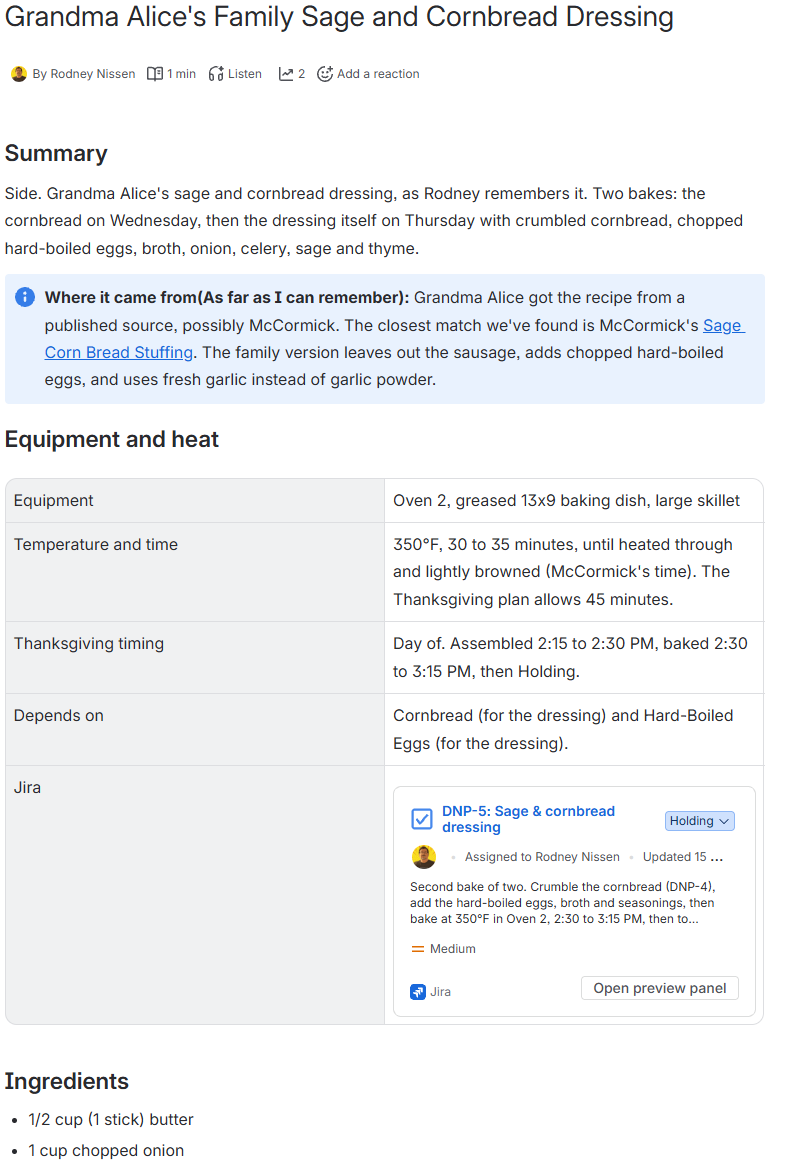
The payoff comes next month, when a Christmas dinner epic’s dressing work item links to the same page. Maintained once, planned many times: the same split you want between a Confluence runbook and the change tickets that execute it.
Writing the recipes down also turned up a problem I didn’t know we had. Grandma Alice’s dressing is a family standard, and when I sat down to document it, I couldn’t say for sure how many eggs go in. I guessed six. My sister wasn’t sure either. The answer turned out to be three, half my guess. It has only ever lived in a few people’s heads. Every admin has met the work version of this: the automation rule nobody can explain, built by someone who left years ago. The fix is the same in both kitchens. Write it down while someone still remembers.
Grandma Alice’s Sage and Cornbread Dressing, As Best We Remember It
Grandma Alice got this from a published recipe, possibly McCormick, though I could be wrong. The closest match I’ve found is McCormick’s Sage Corn Bread Stuffing. Ours drops the sausage, adds chopped hard-boiled eggs, and (in my kitchen, at least) uses fresh garlic in place of garlic powder.
- 1 stick butter
- 1 cup chopped onion and 1 cup chopped celery
- 2 teaspoons rubbed sage and 1 teaspoon thyme
- Fresh garlic, minced, to taste
- About 10 cups crumbled cornbread, baked the day before
- 3 hard-boiled eggs, chopped
- 1 can (14½ ounces) chicken broth
Soften the onion and celery in the butter, add the garlic and herbs, fold everything into the cornbread with the eggs, toss with the broth, and bake in a greased 13×9 at 350°F for 30 to 35 minutes, until it’s hot through and lightly browned.
Jennifer’s Cranberry Sauce
Jennifer’s is a standard homemade cranberry sauce, essentially the recipe printed on the bag: a 12-ounce bag of fresh cranberries, a cup of sugar and a cup of water. Boil the sugar and water, add the berries, and let it bubble gently for about ten minutes, until the berries pop. It sets up as it cools, which is why it’s made the day before.
Where the Board Runs Out
A thought experiment that only flatters the tool isn’t worth much, so here’s the gap. The board is excellent at flow: what’s in the oven, what’s queued for it, who’s overloaded, what’s getting cold in Holding. What it doesn’t do natively is the minute-by-minute schedule. Jira’s built-in start and due dates are dates, not times, and the timeline plans in days. Thanksgiving plans in fifteen-minute increments, so the table above is the real plan and the board is how you watch it execute. You could stretch Jira with a date-time custom field and a filter sorted by it, and for a release cutover with a fixed maintenance window that might be worth it. For one dinner, it isn’t.
Wrapping Up
We aren’t hosting this year, but every constraint in this post is going to be real for millions of people this season: two cooks, two oven doors, a toaster oven pulling double duty, and a fridge that was full before anyone planned for it. Jira handled more of that than I expected. But the dinner was never really the point.
Swap the turkey for a production cutover, a migration weekend, or a go-live with a date the business has already announced, and every lesson carries over unchanged. Find the real constraint and set your limits from what it can actually hold. Give waiting its own column, because work blocked on capacity and work that’s moving look identical otherwise. Schedule backward from the date that can’t move. Pull everything you can off the critical day, then check where it went, because early work has to sit somewhere, and that somewhere has limits too. Put your buffer right after the estimate you trust least. Tell your outside dependencies when to show up instead of letting them pick. Decide what’s droppable before the crunch. And write the process down while someone still remembers it, because “how many eggs?” is a lot less funny when the question is about your rollback steps.
The board will tell you when the oven is full. It won’t tell you the turkey is bigger than the rolls. That judgment is still yours, and on a project that can’t be late, it’s the part that matters most.
So here’s a ten-minute job before you log off for the holiday. Find the column on your team’s board that sits in front of the real constraint: code review, QA, or the one person who can approve a change. Set a maximum on it equal to what it can really handle. Then look at what’s sitting in the column before it. Those work items aren’t in progress. They’re waiting for an oven.
Then close the laptop. The board will still be there Monday. Whoever is doing the cooking at your house this week, go thank them, and maybe offer to carve.
I’m curious what the turkey is on your board: the one item that eats half your capacity and that everything else has to be scheduled around. I’d like to know what you find.
Happy Thanksgiving to everyone celebrating tomorrow, and a belated one to my friends in Canada.
Until then, this is Rodney, asking: have you updated your Jira issues work items today? (And has anyone checked the turkey?)
Enjoyed this one? These posts are free and always will be — but if this saved you a headache or taught you something worth keeping, you can drop a tip in the Ko-fi jar. No paywall, no subscription, no catch. Just a thanks if the writing earned it.
→ Support The Jira Guy on Ko-fi
Discover more from The Jira Guy
Subscribe to get the latest posts sent to your email.


