
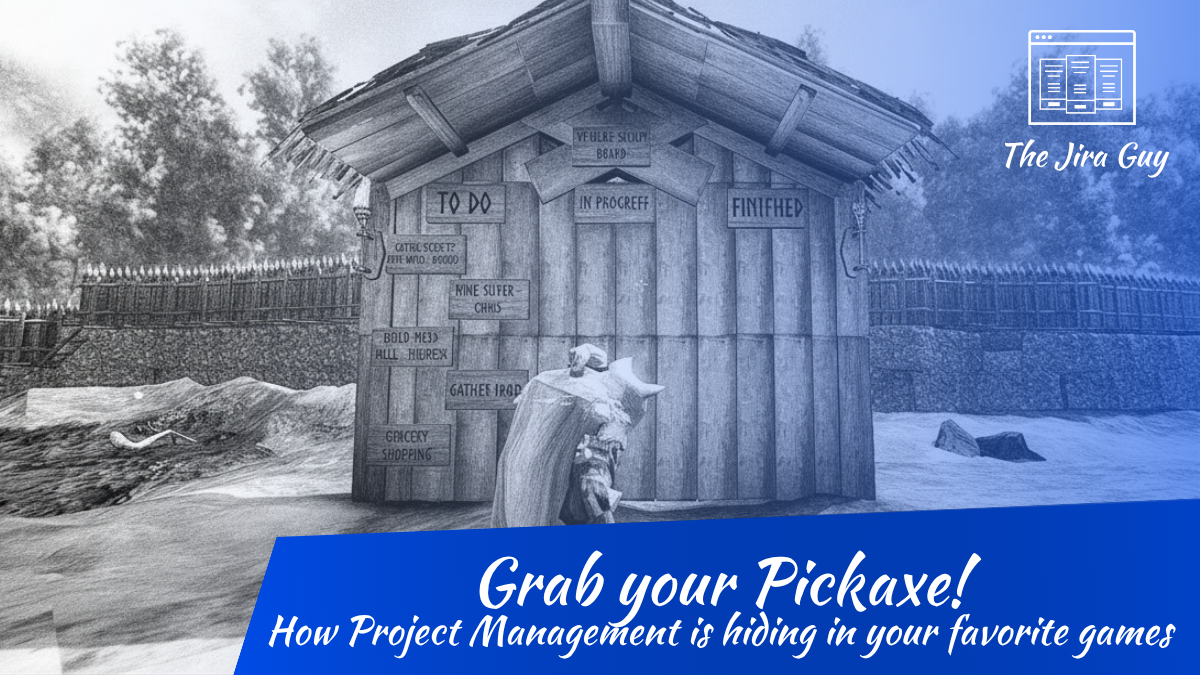
A few years ago I built a Scrum board out of wood and torches in Valheim. Carved columns: To Do, In Progress, Finished. Little signs for the cards. “Mine silver, Chris.” “Build mead hall, Theresa.” “Gather iron.” And, because somebody has to keep a board honest, “Grocery shopping.” It was a joke for the crew I played with, a server’s worth of people who wrangle Jira for a living, which is the kind of detail that makes a board like this basically inevitable.
The embarrassing part is that it worked. Not as a bit. As an actual board. And once I noticed that, I could not un-notice the bigger thing behind it: a lot of the games I love are just project management wearing much better graphics, and Jira fits them more naturally than it has any right to.
These games are actually work
My preferred game for years hasn’t been the standard “Call of Halo: Modern Battlefield.” No, I prefer a weird combination of Factory, Survival, and City Planner games. Things like Valheim, Minecraft, Timberborn, Factorio, Satisfactory, Dyson Sphere Program, and Oxygen Not Included. Strip the art away and the loop is identical. You have a goal. The goal is too big to just do. So you break it into smaller pieces, you tackle them in an order that respects what depends on what, and finishing one unlocks the next. If that sentence gave you a small involuntary twitch, it’s probably because you’re having a flashback to your last Sprint planning session.
These are not idle clickers. Those games have their place, but in the games I prefer, progress is earned, never handed to you. You do not wander into the next tier, you build your way there, piece by piece, and the building is a stack of projects leaning on each other.
Where Jira fits almost too well
Valheim is the clean example, because it puts the dependency chain right in your face. The bosses gate your progression. You cannot meaningfully mine silver until you have killed Bonemass, because Bonemass drops the Wishbone, and the Wishbone is the only way to find silver buried in the mountains. Iron comes out of the swamp, which you are not surviving comfortably until you have bronze gear from the Black Forest first. Look at that for two seconds as an Atlassian Admin and you stop seeing a game, and just see the Epics and Stories.
The map is almost insulting. The boss, or the biome milestone, is your Epic. “Gather iron,” “mine silver,” “build the mead hall” are your Stories. The progression gating, the thing that physically stops you from skipping ahead, is a dependency link. And the tech tree, the whole picture of what unlocks what, is a roadmap. The factory games make it even more literal. Factorio, Satisfactory, and Dyson Sphere Program are dependency graphs you can walk around inside. Players already half-joke that they are spreadsheets with a frame rate. Only half.
Let’s compare this to another game, Factorio. A coworker of mine once called it “Crack for Sysadmins.” Honestly, I felt personally attacked, mostly because he hit the nail on the head. The entire genre is optimizing a system that punishes a bad decision instantly and visibly, which is, give or take a paycheck, the day job
So yes, you could absolutely run your Valheim base out of a Jira project. An Epic per biome, tasks for every gather-and-build, a board on the wall of the longhouse. I built a version of exactly that, and I am not entirely sure I am sorry. If this sounds familiar, it is because I have pulled this stunt before: the time I used Jira to catch every Pokemon. Apparently this is just something I do now.
And before you write me off as the only person unwell enough to do this, I am not, by a long way. Players build kanban and Trello boards for these games constantly, and the factory genre in particular has spawned an entire cottage industry of planning tools. FactorioLab and the Factory Planner mod are, functionally, dependency-mapping and capacity-planning software for a video game, and folks have shared things like a community-built dependency planner for Satisfactory. People built project-management tooling for these games without anyone asking them to. That is about the strongest evidence I can hand you that the games were project-shaped to begin with.
Minecraft is the interesting one
Minecraft looks like the exception, and it is actually the strongest case in the whole pile. There is no boss gating your progress and no tech tree telling you what to build next. The ultimate goal is yours to set, anywhere from “survive the first night” to “build a working video game inside the video game.”
But do not mistake a freeform goal for freeform work. The second you commit to wanting anything specific, a very real dependency chain snaps into place, and Minecraft’s runs deep. Say what you want to build calls for quartz. Quartz lives in the Nether (a specific area in the game), so now you need a portal to get to the Nether, which requires obsidian, which can only be mined with a diamond pickaxe, which requires diamonds, which you cannot even pick up without an iron pickaxe, because diamond ore mined with anything softer drops nothing at all. An iron pickaxe means you need iron, which requires a stone pickaxe, which means a wood pickaxe (to mine the stone). Wood to stone to iron to diamond to obsidian to the Nether and back…and that is just the critical path! In parallel, you need to find gravel to get the flint to make the flint and steel to spark the fire that activates the portal after you build it with obsidian. And because every one of those steps can get you killed, you inherit side-chains you never asked for: armor so the trip is survivable, food so you do not starve mid-dig, and eventually potions and enchantments for the parts armor alone will not cover.
So Minecraft is not the absence of dependencies. It is all of the dependencies and none of the direction. The graph was always there; the whole crafting and progression tree sitting latent under the surface. What Minecraft withholds is the goal that tells you which slice of that graph you actually have to walk. And that is the purest project management there is, because the planning was never the executing. It was deciding what you are building, which is the thing that decides which chains light up.
Decked Out 3, the build Tango Tek is putting together on HermitCraft, is what this looks like taken all the way. It will be a fully playable dungeon-crawler game made inside Minecraft out of redstone (the Minecraft equivalent of electricity), and its planning document reportedly runs over 40 pages. Decked Out 2 took 13 months to build. That is not someone messing around with blocks. That is a multi-month engineering program with subsystems, phases, and a 40-page spec, run by one person who calls it a hobby. An Epic nobody assigned to him, with a backlog he wrote himself.
That is the real split, and it is not “gated versus not gated.” In Valheim and the factory games, the game hands you the goal and the chain together, on rails. In Minecraft the chains are every bit as real, but the game makes you supply the goal that organizes them. One world plans the project for you. The other makes you be the planner. Guess which skill actually transfers to Monday.
So is this overkill? Obviously.
I am not actually telling you to put your weekend into a Jira project. Maybe. The point was never the tooling. The point is why the tooling slides in so cleanly, and that is because good games and good project management borrowed the same skeleton. Visualize the work. Limit what you have going at once. Respect what depends on what. Agree on what finished means. The games just enforce it with a dragon instead of a stand-up.
Here is the part that stuck with me, and it is a little uncomfortable: the board I built in Valheim felt better than most of the “real” ones I have worked off of. The scope was clean. The progress was visible. Every dependency was something I could see and walk up to. That is not because the game is simple. It is because the game respects the loop, and a lot of our actual instances do not. We let scope sprawl, we bury progress in a hundred half-updated tickets, and we pretend dependencies do not exist until they bite us in a release.
The reason it felt better is that all three legs of the triangle I keep harping on (tooling, process, and people) were finally in balance. The game nails the tooling and enforces the process, which leaves you exactly one job: the people part, the planning, and the calls. At work we keep trying to buy our way out of a people-and-process problem with more tooling. The game will not let you.
Maybe that is why these games scratch the itch they scratch. They are project management that actually pays you back. You can stand in the base you built. You cannot always stand in the thing you shipped at work.
So here is where I land, and it is the opposite of where you think I am going. Like I mentioned, I am not telling you to bring Jira into your weekend. (Again. Probably. You do you.) I am telling you to bring your weekend into Monday. These games are the cleanest project management practice field you will ever get because the feedback is instant and the result is real. You set the goal, break it down, respect the dependencies, and then you either stand inside the thing you built or you watch it fall over—tonight, not in two quarters after a retro nobody showed up to. Real work will never hand you a loop that tight. The games will. Take the reps.
As an Addendum: I have wanted to run a Minecraft server this way for years. A real crew of dedicated Atlassian Experts, one goal agreed on at session zero, the whole thing managed as an actual Scrum team. Sprints, a board, the works. If I ever pull it off, I am definitely thinking of getting Re:Solution to sponsor it under their product: NASA (Not Another Standup App).
But until then, I am Sir Rodney, Third of his name, querying, “Hast thou updated thy quest log this fine day?“
Discover more from The Jira Guy
Subscribe to get the latest posts sent to your email.


