
Fun Man Andy, I think I owe you $5.
Also, I should note a bit of a disclaimer: Opinions in this blog have been and always will be mine – and in no way represent the feelings of ReleaseTEAM, Inc, the other Crewmembers of TJL Media, LLC, or anyone other than me.
We all knew this day would come – but I thought it would be another year or two yet. Atlassian has announced that they are beginning the process to bring Atlassian Data Center products – that is, Jira, Confluence, Bitbucket, and Bamboo – to their end-of-life status after announcing these milestone dates:
- Dec 16, 2025 → No new DC apps can be submitted to the Marketplace
- Mar 30, 2026 → End of new license sales for new customers
- Mar 30, 2028 → End of license sales & expansions for existing customers
- Mar 28, 2029 → Full end of life — environments go read-only
Those are the facts, and the countdown has started. Just like with Server products almost 5 years ago, within a handful of years we’ll be looking at another goodbye.
I hate this decision, but I’m not surprised by it.
The hints have been there for a while – it’s been YEARS since the Data Center got any meaningful end-user features. Then, this past March, they announced the discontinuance of the Data Center Certifications, which I’ll note also aligns so well with the other milestones, that I’m considering it as Step 0 on their plan.
However, let’s look at the other side of the coin. This move will leave customers behind. I’ve said this for a while – Some customers legally will not be able to move to Cloud products. They now have three and a half years to determine what their new tooling will be to replace Jira. And there are plenty of choices out there now in the wake of the Server End-of-Life, so there is at least that.
But I still feel for their Admins. Many of these people I’ve talked with and even given advice to for years now. And although my advice for the past year has been “If you are a DC Admin today, learn Jira Cloud as fast as possible,” I still feel a sense of responsibility to them. I hate that they are going to have to retool and learn a new tool mid-career. I hate that some may lose their jobs in favor of someone who can already manage that tool. Yes, I hate this decision, but I hate it for the people who will be impacted directly.
Numbers…sure…
Atlassian has made no secret that their real goal is to continue to scale and grow – and they see that best being done with their Cloud products. And to be fair, their Cloud products are great. I use Atlassian Cloud as my daily driver Jira and Confluence instances, and at this point have more Cloud Certifications than DC ones. No – for those who can use Cloud, it’s an amazing tool that continues to grow and mature. And even though I know it will be painful, I know some of those who finally make the move from DC to Cloud during these next few years will absolutely love all the new features they’ve been without.
But sure, let’s look at the numbers. During the Server EOL announcement, I pointed out that people in specific circumstances will save money by moving to DC or Cloud. Well, I ran the numbers again. I should be clear, to get the closest parallels to functionality on DC, you will want Cloud Premium – but I threw in Cloud Standard into the mix to see how it compares price wise. All measurements were based on an instance of Confluence and Jira Software, at the various tiers
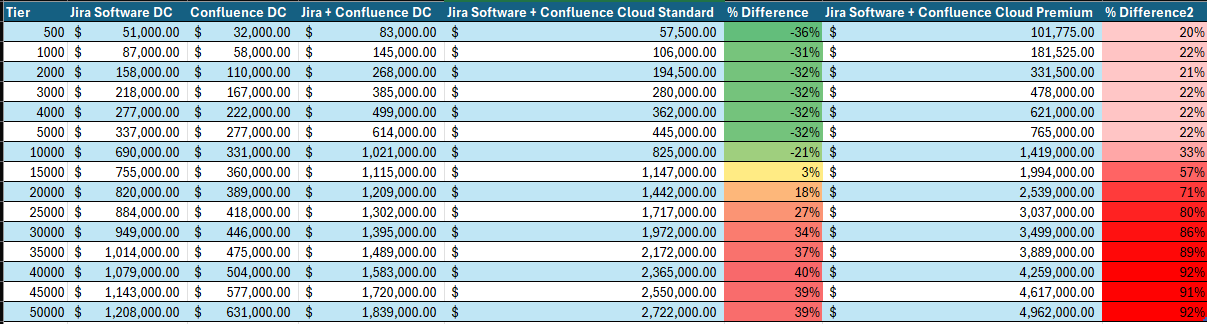
So, to be clear, if you opt for Standard Cloud, you will save money if you have 10,000 users or fewer. But on average, we can expect those who migrate from DC to Cloud to pay around 28%* more. And that’s just the base products – if you don’t have Atlassian Cloud Enterprise, Atlassian Guard is an added cost on top of that – something I did not put into the equations here, but you will absolutely want to consider as it’s a per-user surcharge.
*28% being the average across all tiers. I don’t have distribution data among these tiers, so a more precise number is not possible from me.
So, what is the math here?
Look, Atlassian isn’t dumb – they’ve probably already run similar math. They know they’ll lose customers, but I’m betting they are thinking two things.
First the increase in revenue they’ll get for those who do move to the Cloud will offset any customers they lose. And to be honest, looking at some of the deltas, I do think they may be right here.
However, I don’t think that’s what their main goal is. In 2020, Atlassian was supporting Three different Jiras. They were focusing on too much and that was causing them to not progress as fast as they wanted to. I know I’ve mentioned that a few times – and I could see if you had to sacrifice one, Server made sense at that time. The situation is better now, but Atlassian is still split-focused. They are constantly on the lookout – and fixing – security issues in their DC products and Cloud products. On top of figuring out the new AI paradigm AND developing new features for Cloud. I can absolutely see them wanting to narrow their focus to just Cloud – which right now is 75% of their business – so that they can do all the things they want to do. And honestly, I get that.
But again, doesn’t mean I have to like it.
Those with nowhere to go
So, one use case for DC that’s been close to my heart – as it impacts my family – is those of the U.S. Government and its contractors. While I won’t be getting into politics here now or every, I still want to focus on these.
Indeed, Atlassian is now FedRAMP Moderate certified, which allows some of these organizations to move onto Atlassian Cloud, that doesn’t cover everything. Atlassian realizes this, and have expressed that they’ll earn FedRAMP High and Impact Level 5 before the DC EOL. Honestly, I’d have liked to see this before even doing the announcement, but here we are.
But even if that’s the case, I don’t think it will cover everything. I still hear about a Jira instance so secure that it cannot be connected to the Internet – a practice called Airgapping. The data on this instance will never be able to move to the cloud – and I have to believe one of two things are happening, special plans are being made for this instance (which I would believe exists), or they are looking at other tools now.
Either way, I can’t imagine this news was handled well by these Jira Admins today.
It’s not all bad news
Look, the Atlassian ecosystem has been in a bit of a slump. I’ve heard and seen multiple layoffs and multiple partners over the past six months. And while these are livelihoods, and that should not be forgotten, let’s take a look at why that might be. Back when the Server EOL was announced, Partners started grabbing up every person with even some Atlassian knowledge to help out with the massive workload we were seeing in Server to Cloud or Server to DC migrations. This caused labor’s price to increase, more people learned about Atlassian tools, and life became happier.
Until the Server EOL finished in Feb 2024. Now there are more workers than work to be done, leading companies to shed employees. So, the good news is that there should now be more work at Partners as companies that have moved to or stayed on DC now scramble to get to the Cloud or some other platform. Do I think it will be as much work as during the height of the Server EOL – no. But we should see some growth in the Partners for at least a few years. And this also means – thanks to this essentially being the same pool of people as Atlassian Admins – that those at private companies should also see some improvement there too.
So, where does that put us today?
So, I’m going to be frank with you – this news is still fresh to me. I spent half the time since it broke just trying to confirm it as real, then the rest writing this. So, in many ways I’m still processing and understanding the implications here. That being said, this isn’t the last you’ll hear from me about this. The Jira Life crew is already making adjustments to this week’s episode, and we’d love to hear your opinions on things, too. Be sure to join us this Thursday, at 2 PM Pacific/5PM Eastern to join in over at YouTube.
I’m sure this will be a topic of discussion at both Team ’25 Europe and The Atlassian Builders Summit – Both places where you will be able to find me this year. I’ll be roaming the Expo hall and Barcelona at Team ’25 Europe with Alex Ortiz as we cover the event on behalf of TJL. If you find us, and can prove you are subscribed to The Jira Life on Youtube, we’ll have something special for you. But – it’s a surprise until we announce it later this week.
After that, I’ll be at the Atlassian Builders Summit, where I’ll be showing you how I craft a bespoke workflow in Jira that will make everyone happy. Alex keeps showing me some of the stuff he’s working on for that event, and it’s not something you will want to miss.
But until Thursday, my name is Rodney, asking “Have you updated your Jira issues work-items today?”

 The Jira Guy
Atlassian announced recently on their TEAM conference that they’re going to offer the Isolated Cloud option. I think this is the step in this direction.
I will not be surprised if Atlassian offers a self-hosted cloud in future too. Imagine a scenario where Atlassian delivers software components for Jira Cloud and scripts to deploy them, and customers host them on their own in their air-gapped data centers.
LikeLike
We have 10 data center environments and over 20+ air gapped servers that run fully contained in a lab and with our current government contracts, those labs can not have access to the external internet.
This decision seems insane to me. We spend millions on license, Premier support, plugins etc and now we have 4 years to find a replacement.
LikeLike